



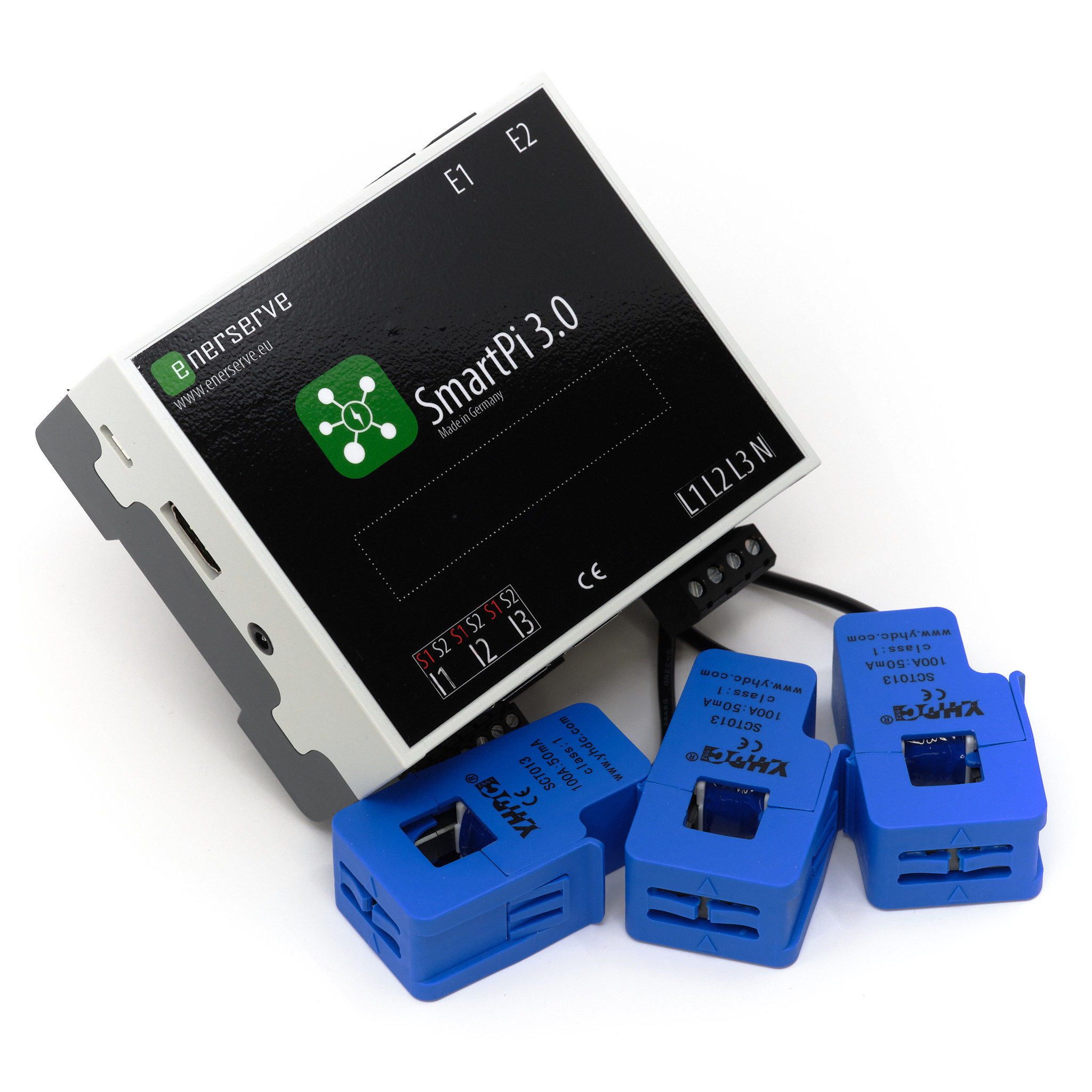
The SmartPi 3.0 expansion module adds voltage measurement and contactless current measurement interfaces to the Raspberry Pi, transforming it into a fully-fledged smart meter that monitors and records electricity consumption and generation, and makes this data available via a network or the internet.
The SmartPi measures all key data:
Voltages
Power
Active power
Reactive Power
Apparent power
Consumption
Production
Power consumption
Power production
Frequency
Cos Phi

With the SmartPi, electricity is measured contactlessly via a cable-mounted current transformer
Connectivity expert
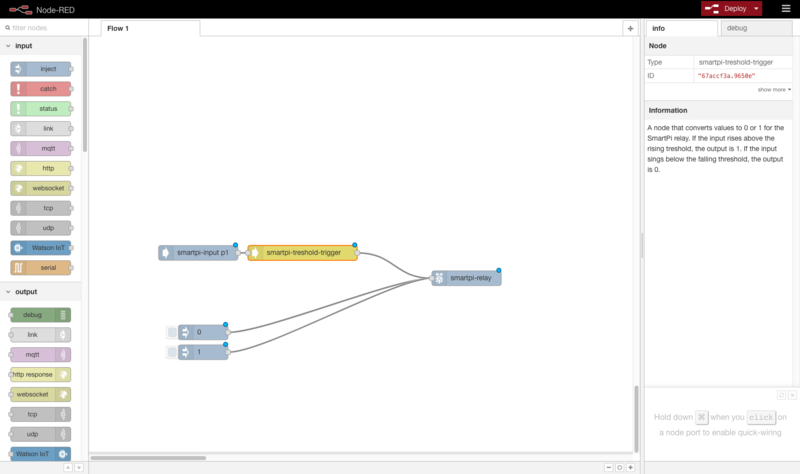
Custom Node-RED modules enable integration into more complex control processes
The SmartPi’s built-in web server makes the measurement data available in a graphical format, which can be easily accessed via a browser or a tablet/smartphone.
The SmartPi features MQTT and REST interfaces for integration with other energy management systems.
A Modbus interface (TCP) completes the package.
In addition, CSV files containing energy measurement data can be saved to other servers via FTP.
Open-source smart meter for the Raspberry Pi
It’s ideal for using the SmartPi in your own projects or for extending its functionality.
Examples of projects that can be built using the SmartPi:
- Energy monitoring via the network and the internet
- Mains frequency monitoring
- Mains voltage monitoring
- Alarme bei Stromverbrauchern
- Alerts for high consumption
- Integration into energy management systems
- Cost control
The SmartPi 3.0 features an RTC (Real-Time Clock) to ensure reliable operation even without a network connection. The entire system is powered by the integrated power supply unit using the measured voltage. This eliminates the need for fiddly connections using power adapters on micro-USB sockets.

Real-time monitoring of current, voltage and power
Reading out a wide range of additional data every second
Save the values to the database every minute
MQTT-Support
Prometheus support (not yet documented)
Node-Red integration
Modbus-TCP
Modbus RTU (via expansion module)
CSV-FTP-upload
Web interface for display and configuration
EMETER Protocol
LoRaWAN support (via expansion module)
Raspberry Pi-compatible connector
Raspberry Pi-compatible size
Electrical isolation
Integrated power supply from the voltage measurement path via stable terminals (optionally 2A DC current)
Open-source drivers and API
Three-phase current measurement
Connector for a cable conversion adapter with a secondary output of 50mA, 333mV and 1A (optionally 5A for the SmartPi 3.1)
Screw terminals for connecting current and voltage measurement
Compatible with all Raspberry Pi models
Buffered RTC (the Raspberry Pi continues to run stably even without an internet connection following a power cut)
High-quality housing with DIN rail mounting
External I2C connection via modular sockets
External SPI connection via modular sockets
Technical specifications
| SmartPi module | SmartPi with Raspberry Pi | |
| Voltage measurement range | 0–230 V rms | |
|
3-phase or 3 x single-phase |
||
| Current range | depending on the current transformers (0–100 A with the supplied transformers) | |
| 3-phase (non-contact, using current transformers) | ||
| Measurement accuracy | 2% | |
| Power consumption | 0.02W | 3.7W |
| Connections | Raspberry Pi connector | LAN, 4x USB host, audio |
| Voltage measurement, current measurement, screw terminals | ||
| Pins used |
3,3V, 5V, I2C1_SDA, I2C1_SCL |
|
| Dimensions (LxWxH) | 108x90x55mm | 108x90x55mm |